The Future of Quantum Computing: Hope, Hype, and Reality
Abstract
Quantum computation's entry is considered to be the next breakthrough in the field of innovation. Scientists often believe that it is going be the next revolutionary leap in the information technology sector.
Abstract
Quantum computation's entry is considered to be the next breakthrough in the field of
innovation. Scientists often believe that it is going be the next revolutionary leap in the
information technology sector. But for many of the people, especially for the new comers like
us, it still feels very much puzzling and distant due to the absence of prior knowledge. We
hear a lot of bold claims about the transformation of industries due to the entry of Quantum
Computing, while we are also told at the same time that the technology is still far from being
fully ready. This blog will provide us a complete look at quantum computing by exploring the
hopes surrounding it, the hype that inflates expectations, and the reality of the current state
of technology.
Introduction
Nowadays Quantum computing has become one of the most discussed topics in the modern
world of technology. We witness a lot of news headlines where the predictors are claiming
that it will change all—from cybersecurity field to medicine sector —while others believe it as
hype-driven science. As readers, we’re often failed to choose the right topic on which we can
believe. Is quantum computing really the future, or is it just another trendy term carried by
hype? To answer that, we need to pause and look at both its limits and its promises with a
clear vision.
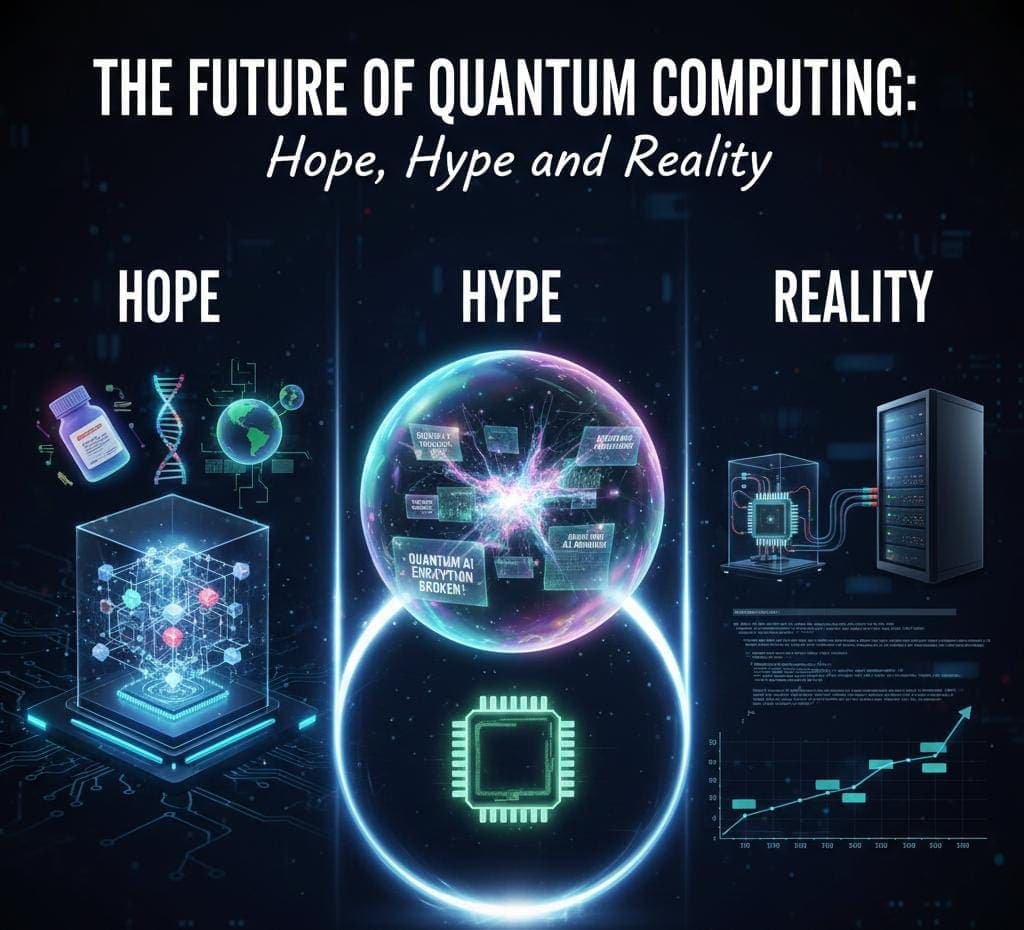
The Hope regarding Quantum Computing
There is a lot of excitement regarding quantum computing and thereexists a reason behind
this excitement. Unlike classical based computers, which process linear way of information
passing, quantum computers can find or explore various possibilities at a time. This opens
the door of solving extreme level of complex problems. We may see significant
breakthroughs in areas like discovery of drugs, material science, simulation of climate, and
complex optimization problems that are currently beyond the capability of classical machines
to solve them. When we estimate about these possibilities, it’s easy to understand why both
the tech companies and researchers are so much excited and hopeful about it . The hope is
not imaginary—it is supported by real and solid scientific principles.
The Hype that makes people confusing
However, the news and the hype around the quantum computation often creates a lot of
expectations which seems to be unrealistic in nature. A lot of articles suggest that quantum
computers are just around the corner and are ready to replace our daily devices or instantly
break all the existing encryption models. That’s simply not true. We cannot say that Quantum
computing is a just “faster computing,” and it will not solve each and every problem in a
surprising manner. When we start mixing up the possibilities of future with the one that are
existing today, we lead us to the confusion of real progress with the unfulfilled promises. All
this can lead people, like us, to think either in an overly excited way or in a complete
doubtful way.
The current state of Quantum Computing which Stands Today
In real, in the present time, quantum computing is still in its experimental phase. Current
quantum based systems are very much weak and also they are highly sensitive in nature.
Even small piece of disturbances can cause a lot of errors, which lead to difficulty in making
reliable computation. At present, most of the quantum based computers are used in
research based labs rather than in the real-world applications. We are still working on
building of stable machines, reduce the level of errors, and scale them in an effective way.
Progress is underway, but at a slow careful pace, and far from becoming a widespread
adoption.
What the upcoming Future Might Look Like
Instead of waiting and expecting a sudden quantum breakthrough, we should focus on a
steady process for expecting a gradual change. In the coming days, quantum computers are
more likely to operate alongside the classical computers instead of replacing them. We may
witness a revolution where new types of hybrid systems will be introduced in the field of
technology. These hybrid models will contain both quantum and classical systems, where
quantum part will handle the specific, complex works while classical systems manage the
rest. This practical approach is more reasonable than the quantum technology that we are
assuming to take overnight. Their progress is expected to follow a slow path, in a
step-by-step trajectory rather than a sudden transformation.
Conclusion
We can view quantum computing as a field of real promise and as a balance between
excitement and reality. It remains powerful in potential, realistic in its pace and driven by
authentic or real research.